Find out which of the nine stages of meditation you are on.
Most teachers never take a student into the finer states of concentration. It is rarely for want of trying: the map is old, the texts are scattered, and very few people have both to hand. We have gathered them into one place, alongside somewhere to record your practice, so you can keep improving day after day.
The map is the nine stages, and it is sixteen hundred years old. Attention settles in nine recognisable steps, in the same order for everyone, and the teachers who set them down wrote out what helps at each one. Awakening Daily reads each of your sessions against it.
After every session you get back:
- Which of the nine stages you are standing in
- What is going well
- The one thing to work on next
- Passages from seven lineage texts, chosen for your practice
- An answer to any question you ask about it
And once a month, you can bring your questions to a real teacher.
One week free · no card · cancel in one click
- 7books your advice comes from
- 108passages matched to your sessions
- 9stages, and you learn yours
- 15centuries of practice behind it
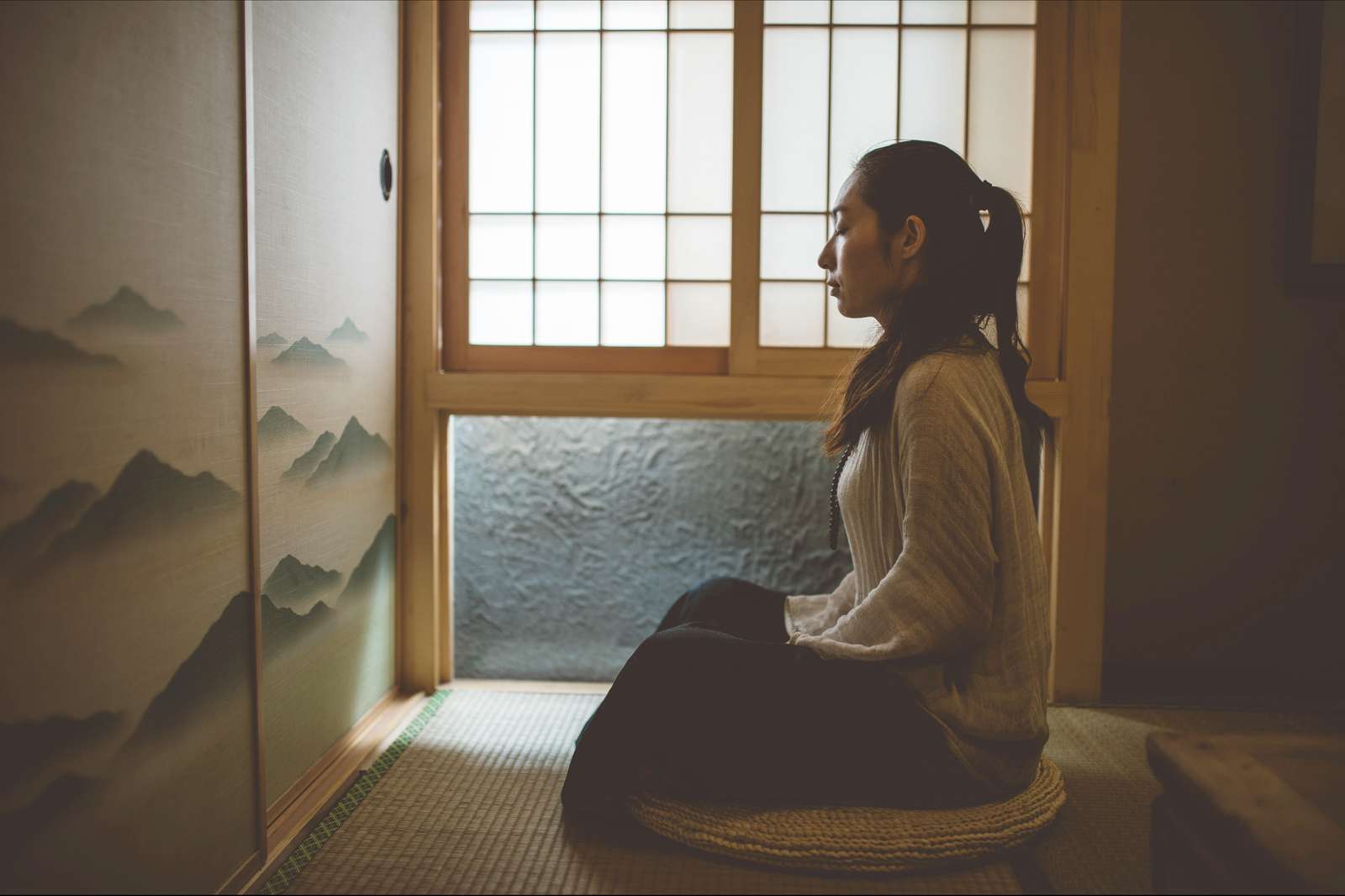
A steady mind is your tool for realization. We help you build one, and we help you choose what to place it on. Any of these three is worth the whole training.
Compassion and love
Love wants people to have happiness and whatever causes it. Compassion wants them free of suffering and whatever causes that. Start with someone easy, then a stranger, then someone difficult, and watch where the wish thins out and where it closes.
That closing is the work. Holding these two breaks down the mind's habit of dividing the world into self and other, and carries your concern past the small circle attachment draws around it. Great compassion is the indispensable cause of bodhicitta, the mind that seeks awakening for the sake of everyone. Grown to its full size, it changes the direction of a life.
Impermanence, the fact that everything is undergoing change moment to moment
Everything made by causes and conditions is changing, and this life is both rare and certain to end. Take the breath, or a sound, and watch for the moment it holds still. You will not find one.
Sitting with this cuts through one of our deepest distortions. We live as though the people, the circumstances, the possessions and the body we lean on will stay. As that loosens, the concerns of this life weigh less and practice takes on urgency, and the mind turns towards liberation rather than towards the next comfortable thing.
Emptiness, or the clear light nature of consciousness
Things appear to stand up solidly from their own side, and nothing can be found that exists that way. They exist dependently, through causes and conditions, through their parts, and through being named. Take a cup and go looking for it apart from all of that, and keep looking until nothing is left over.
This is the one that reaches furthest, because grasping at things as inherently existent is the root holding cyclic existence in place. Seeing emptiness does not cancel the ordinary world. It shows why a dependent world is possible at all. Realised directly, it cuts that root. Joined with the wish to awaken for others, it carries the path all the way.
And here is the path that gets you there.
It is hard to know where you are in your practice.
Learn how today, with the nine stages of meditation. Everyone passes through them in the same order, and four sessions is enough for us to show you which one you are standing on.
You might be further along in your practice than you know.
Find out where you are. One session tells you almost nothing, but twenty tell you a great deal, and every entry you make moves the line. It climbs on its own arithmetic, whether or not today felt like anything at all.

Learn to notice what every advanced meditator notices.
Working with this system teaches you the six things the tradition actually watches, one session at a time. Good or bad is too blunt to improve anything. These six are kept apart on purpose, because they ripen at quite different speeds, and watching them separately is how you see progress that a general impression hides.
How long you stayed with whatever you were watching before the mind wandered off. Early on this is the only one that matters. The other five can wait.
How bright and sharp the object appeared while you held it. Clarity grows on its own schedule, quite separately from how long you managed to stay, so a short bright session can be a very good one.
How much grip you had on it. Not the same thing as clarity, and the one most practitioners have never been asked about, which is exactly why it repays attention.
Whether what you sat down to do was still with you at the end. Forty minutes with the instruction intact goes somewhere completely different from forty minutes without it.
Whether some part of you was quietly keeping watch. This is the part of you that notices mid-session, while there is still time to come back. It can be trained.
How much effort it took to stay with it, from forcing every moment to needing none. This is the one that gets easier: over the months it asks less of you, not more.
Start at eleven minutes, which almost anyone can find in a day. From there we add five a week. It is gentle enough that most people are sitting for an hour before it occurs to them to be impressed. There is a breather at thirty minutes and another at forty five, so the climb never gets ahead of you.
See a real reading before you sign up for anything.
Think of a session you remember and answer the six questions about it.
Once a month, sit with someone who has walked it.
Finding a teacher in this tradition usually means knowing somebody, or living near a monastery. On the monthly call you meet one: decades on the cushion, trained in a lineage handed down unbroken, and your questions answered live.
A fully ordained monastic
Full ordination means taking the complete monastic vows and keeping them for life. The Geshe degree comes on top of that: fifteen to twenty years inside the five great treatises, on wisdom, the middle way, logic, the workings of mind, and monastic discipline.
The examinations are spoken, not written. A candidate stands in the courtyard and defends what they know against the whole assembly. It is a harder test than any paper, and much better preparation for answering your question on a call.
Five years of study, and real time in retreat
Five years of formal study, alongside a substantial period of meditation retreat. Several of our teachers have completed the classical three years, three months and three days. That is a stretch of life given entirely to practice, with nothing else asked of them.
That is what lets them tell you how a stage actually feels from the inside rather than from the page. Whatever you are running into on the cushion, they have almost certainly run into it themselves, and they know what helped.

Every piece of advice comes from authentic, lineage-based source texts on meditation.
Nothing new age, and nothing invented. Only what the tradition has actually handed down, put where it can help your practice.
There is a great deal of meditation advice in the world, and very little of it says where it came from. These seven works span fifteen hundred years, beginning with the Buddha’s own instructions on watching the breath. We have cut them into a hundred and eight pieces, so the app can find the passage that fits your session and show it to you.
Week one is free.
Take the journal on its own, or the journal with a teacher in the room once a month. No card for the first week, and if it is not for you, one click stops it and your entries stay readable.
- The daily entry and the timer
- A reading after every session
- The weekly reading of the whole log
- Every chart, and the whole register
- All seven texts, one hundred and eight sections
- Everything in The Journal
- A live monthly call with one of our teachers
- A two hour live teaching on developing concentration through the stages of meditation
- Recordings of both, kept
- Questions answered on the call
- Everything in The Sangha
- A private hour each month with a professional mentor, someone with a doctorate equivalent, or years of full time meditation retreat behind them
- Your register read before you meet, so the hour is spent on you
- Written answers between calls
- Your object and your ramp set with the teacher
No card for the first week. Every tier opens the journal, which also runs on its own with nothing connected. Cancel in one click and your entries stay readable.
Your entries sit behind your own email and password. Not shared, not sold, not used to train anything. Export the whole record or delete the account whenever you like.